
Photography is a fast evolving industry and the mirrorless camera has become one of the most influential trends in photography today. Regardless of whether you are an amateur photographer, a traveller, or a professional photographer, knowing what is a mirrorless camera is may aid you in selecting the most suitable tool in your creative endeavours. This article will discuss the functionality of mirrorless cameras, their strengths and weaknesses, and how they are supplanting the DSLRs as the new face of contemporary photography.
Table of Contents
What Is a Mirrorless Camera?
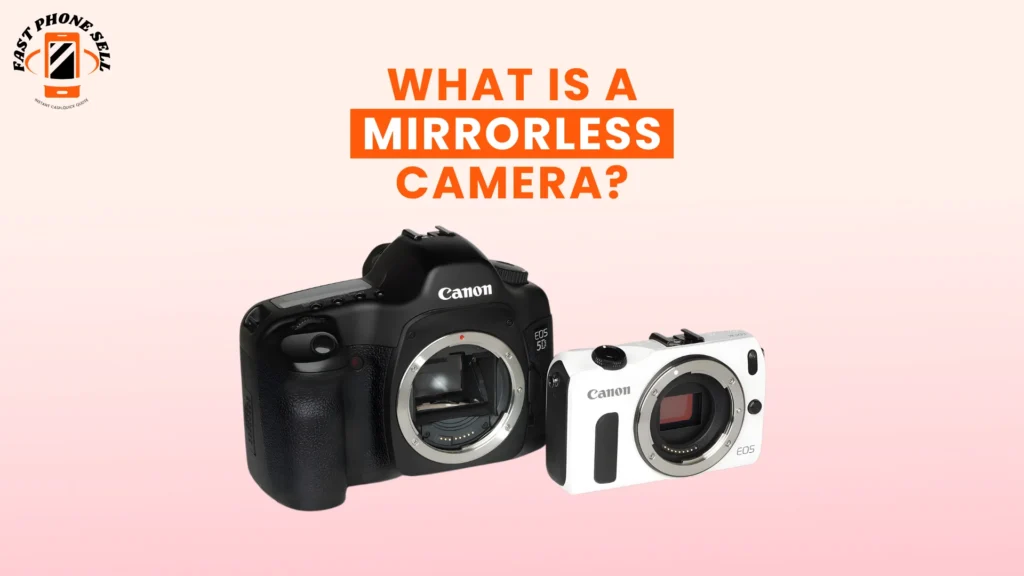
A mirrorless camera refers to a category of digital cameras that lack a reflex mirror as in the case of the old DSLR cameras. Rather, the light goes through the lens and lands on the image sensor forming a live image on the LCD screen or electronic viewfinder (EVF).
Simply put, mirrorless cameras eliminate the bulky mirror mechanism of DSLRs, which permits a smaller, lighter design. This is why they are good in situations where a photographer requires high image quality without the heavy equipment. Mirrorless digital cameras are faster, quieter and more efficient because of this innovative structure.
The exposure, color and depth of field can be viewed before a photo is taken, which is one of the biggest advantages, and it is particularly beneficial to beginners who need to learn about manual settings.
How Mirrorless Cameras Work
To learn how mirrorless cameras work, consider that the light enters the lens and the image sensor directly. The sensor then transmits a live preview to the LCD or EVF, which lets you see a live preview of your shot.
Mirrorless interchangeable lens cameras (MILCs) can record continuously and quietly since instead of flipping the mirror up and down, the mirror is absent. They also contain less moving parts, which will be more reliable in the long run.
Professional models have the in-body image stabilization (IBIS), artificial intelligence-based autofocus, and subject tracking in real time, which is appropriate in photographic and video applications.
This design breakthrough has popularized mirrorless cameras among hybrid artists who both take photos and record videos – something that the DSLRs cannot do easily.
Mirrorless vs DSLR: Key Differences
The comparison of the mirrorless and the DSLR reveals a number of key differences which influence performance and usability.
Size and Weight
Mirrorless cameras are much smaller and less heavy since they do not have a mirror box or optical prism. This makes them convenient to carry when traveling or a long shoot. This is a big advantage to vloggers and street photographers.
Viewfinder Technology
DSLRs have an optical viewfinder (OVF), which allows you to view the real image through the lens. By comparison, mirrorless cameras have an electronic viewfinder (EVF) which shows a real-time digital image of the sensor. The EVF lets you view exposure, white balance and color options and make adjustments before the shutter is pressed.
Autofocus Performance
Newer mirrorless cameras have built in high-tech phase-detection autofocus systems on the sensor. This allows it to focus more quickly and precisely particularly on moving objects. DSLRs, though dependable, tend to use independent focusing units, which may be slower in live view.
Lens Ecosystem
Mirrorless camera systems are rapidly catching up on the long-established lens range of DSLRs. Popular mounts such as Sony E-mount, Canon RF-mount, and Nikon Z-mount are now provided with a large selection of lenses. Lens adapters are also available to add older DSLR lenses to mirrorless bodies without compromising quality.
Advantages of Mirrorless Cameras
Mirrorless cameras have many advantages which render them attractive to amateurs and professionals alike.
Compact and Lightweight
Mirrorless camera is more portable making it ideal in travel photography and daily use. Although small, they can provide the same image quality or sometimes a higher image quality compared to their bigger DSLR counterparts.
Silent and Faster Shooting
The lack of a mirror makes the camera almost silent and high-speed burst shooting. This makes them very suitable in events, wildlife and wedding photography where noise may be disruptive.
Real-Time Image Preview
The electronic viewfinder will display the exact appearance of your photo prior to taking a photograph. This has exposure, shadows, color, and background blur – allowing you to control the end result even more.
Superior Video Features
A wide range of mirrorless digital cameras target hybrid creators, with the capability to record 4K, 6K, and even 8K video at high stabilization and autofocus tracking. This is why mirrorless systems have become the favorite among the majority of YouTubers and filmmakers nowadays compared to DSLRs.
Cutting-Edge Technology
Innovations such as AI subject detection, eye autofocus (Eye AF), and real-time tracking are first introduced in mirrorless cameras. They also include Wi-Fi, Bluetooth and USB-C connectivity, which means faster and convenient file transfer.
Disadvantages of Mirrorless Cameras
Mirrorless cameras have some challenges despite their benefits. The biggest disadvantage here is battery life because the EVF and sensor is always on a power-drain. There are also models with a restricted range of lenses, but this is changing quickly.
Price is another issue of concern – a full-frame mirrorless camera and lenses can be costly. Moreover, EVFs might not appear natural to photographers accustomed to optical viewfinders. Nevertheless, the vast majority of specialists accept that these small negative points are compensated by the technology and performance which mirrorless systems provide.
How to Choose the Right Mirrorless Camera
The choice of the most suitable mirrorless camera can be made based on your level of experience, objectives of photography, and finances.
Determine Your Use Case
As a beginner, you should find entry-level mirrorless cameras, such as the Canon EOS R10, Sony ZV-E10 or Nikon Z50. They are low priced, lightweight and convenient to use. As a professional, you can consider the full-frame models like Sony A7 IV, Canon EOS R6 Mark II, or Nikon Z6 II that provide an excellent performance and image quality.
Consider the Sensor Size
The mirrorless cameras are available in various sensor sizes full-frame, APS-C, and Micro Four Thirds. Full-frame sensors have the highest quality of images and performance in the dark, whereas APS-C and Micro Four Thirds are smaller and cheaper.
Evaluate the Lens Ecosystem
Select an established brand with a robust lens collection and future. Sony is dominant in the variety of lenses, and Canon and Nikon are rapidly diversifying in mirrorless. In case you are already having DSLR lenses, you can use the adapter to make a smooth transition to a mirrorless system.
Look for Advanced Features
In-body stabilization, weather seals, dual memory slots, and rapid autofocus may make a great difference. Videographers are advised to seek cameras with 4K 60fps or 10-bit record capabilities.
Popular Mirrorless Camera Brands
Sony Mirrorless Cameras
Sony leads the market with its Alpha series, which has quick autofocus, small size and remarkable video performance. Among the finest mirrorless cameras of 2025, there are Sony A7C II and A6700.
Canon Mirrorless Cameras
The EOS R system by Canon has a rich color science, dual-pixel autofocus, and an ever-expanding selection of quality RF lenses. Canon EOS R8 will suit creators in need of versatility.
Nikon Mirrorless Cameras
The Z-series of Nikon is a blend of toughness, excellent ergonomics, and the ability to capture amazing images in low-light conditions. Nikon Z5 and Z6 II are ideal all-rounders.
Fujifilm Mirrorless Cameras
Fujifilm is unique due to its retro design and film simulation modes. X-T5 and X-S20 are popular among portrait and travel photographers.
Panasonic Mirrorless Cameras
Videographers have extensively praised the Panasonic Lumix GH6 and S5 II due to their high performance 4K video recording and excellent stabilization systems.
The Future of Mirrorless Cameras
Mirrorless cameras are the unquestionably the future of photography. With the advancement of the technologies, we are witnessing the introduction of AI-controlled autofocus, improved low-light sensors, and improved heat-management during the use of the long video durations.
Major brands have now changed their entire focus to mirrorless development, which is why DSLR production is being phased out slowly. Mirrorless digital cameras will take over the professional and consumer markets by the year 2025 and beyond, with image quality, speed, and performance that is unmatched at all levels.
Conclusion
To sum it up, mirrorless camera is not just a smaller-sized digital camera, it is the latest advancement in imaging technology. Its compact structure, live preview, high-quality automatic focus, and versatility in video recording make it a perfect fit to all kinds of photographers.
Are you still asking yourself: What is a mirrorless camera and should I get one? The answer is simple: yes. Whether you are recording travel memories, shooting content, or working on professional photography, a mirrorless camera will provide an ideal combination of innovativeness, quality, and freedom in creativity.
FAQs About What Is a Mirrorless Camera
What is the difference between a DSLR and a mirrorless camera?
A DSLR has a mirror and optical viewfinder whereas a mirrorless camera has an electronic viewfinder which gives a live preview of the image sensor.
Are mirrorless cameras better for beginners?
Yes, they are smaller, simpler to operate and display real-time exposure preview and are therefore best suited to new photographers.
Can DSLR lenses be used on mirrorless cameras?
Yes, most mirrorless camera bodies can use adapters on their lenses to use DSLR lenses with autofocus performance being slightly reduced.
Are mirrorless cameras good for video recording?
Absolutely. They are designed to be used as hybrids and provide great video quality, stabilization, and frame rate such as 4K and 8K.
Do mirrorless cameras have shorter battery life?
The life of the batteries is reduced slightly since it is used constantly but the modern ones have longer lasting batteries and also have the option of USB-C charging.